Freelancing has gone from a side gig to a serious career path. More than 64 million Americans now freelance, and that number is climbing fast.
Whether you want extra income, full control over your schedule, or a complete escape from the 9-to-5, the right freelancing tips can save you months of trial and error.
This guide takes you from the absolute basics — what freelancing actually is — all the way to advanced strategies for raising rates and scaling. No fluff. Just what works.
What Is Freelancing?
Freelancing means working for yourself and selling your skills directly to clients, instead of working as an employee for one company.
You're not on anyone's payroll. You're an independent contractor who chooses your projects, sets your own rates, and decides how and when you work.
A freelancer can be almost anyone with a marketable skill: writers, designers, developers, marketers, video editors, virtual assistants, consultants, and more. You handle the work and run the business behind it.
In short: you trade the security of a steady paycheck for freedom, flexibility, and unlimited earning potential.
Freelancing by the Numbers
Freelancing isn't a fringe lifestyle anymore — it's reshaping how the world works.
A few statistics worth knowing before you start:
Freelancers contribute an estimated $1.27 trillion to the U.S. economy each year. (Upwork)
By 2027, freelancers are projected to make up roughly 50.9% of the U.S. workforce — the majority. (Statista)
78% of CEOs say their top freelancers deliver more value than degree-holding full-time employees. (Upwork)
Around 60% of people who left full-time jobs to freelance report earning more than they did before. (Upwork / DemandSage)
52% of Gen Z already freelance, making them the most independent generation in the workforce. (High5)
The takeaway is simple: demand for skilled freelancers is rising, not shrinking — even in the age of AI.
The Pros and Cons of Freelancing
Before you dive in, be honest about the trade-offs. Freelancing rewards you with freedom but hands you full responsibility for everything an employer used to handle.
Pros of Freelancing;
Set your own schedule and work from anywhere
Choose your clients and projects
Unlimited earning potential — raise your rates anytime
Keep 100% of the value you create (no middle manager)
Build skills across business, sales, and your craft
Scale into an agency or passive income later
Cons of Freelancing
Income can be irregular, especially early on
No paid leave, sick days, or employer benefits
You handle your own taxes and insurance
Can feel isolating without a team
You're responsible for finding your own work
"Feast or famine" cycles require careful budgeting
If the cons feel manageable and the pros excite you, freelancing is probably worth a serious try.
Freelancing Tips for Beginners: How to Get Started
If you're learning how to start freelancing, resist the urge to build a logo or a fancy website first. Start with the fundamentals below.
1. Get clear on your "why"
Freelancing tests your patience with quiet weeks, rejection, and self-doubt. A strong reason — freedom, income, ownership of your work — keeps you going when results are slow.
Write it down. When a slow month hits, your "why" becomes the anchor that stops you from quitting too early.
2. Pick a skill the market actually pays for
The best freelancing skills for beginners sit at the intersection of what you're good at and what businesses will pay for.
Don't ask "what pays the most?" Ask "what am I already decent at — and who needs it right now?" Writing, design, web development, data analysis, and marketing are all reliable starting points.
3. Niche down (eventually)
It's fine to experiment at first, but specialists out-earn generalists. A "content writer for SaaS startups" is far easier to hire than a "writer who does everything."
Niching makes you the obvious choice for a specific client — and lets you charge more.
4. Build a simple portfolio
You don't need paid clients to start a portfolio. Create sample work: redesign a landing page, write a mock article, or build a small demo project.
Clients buy proof, not promises. Show how your work solves a problem, not just what you made.
5. Create a credible online presence
You don't need a big brand — you need to look professional and reachable. Get a clean profile on one platform where your clients hang out (LinkedIn for B2B, Instagram for creative work), plus a one-page site with an easy to use tool like Modulify, Framer, Notion, or WordPress.
A professional email on your own domain also helps your outreach avoid spam folders.
Can you start freelancing with no experience? Yes. Most clients care far more about whether you can solve their problem than about your résumé. Sample projects and a clear offer beat a job history.
How to Find Freelance Work That Suits You
Landing clients is a skill you build, not a stroke of luck. Here's how to find freelance work that fits your strengths.
Define your offer in one sentence
Use this formula:
"I help [type of client] achieve [specific result] through [your skill]."
For example: "I help small e-commerce brands increase sales through conversion-focused product descriptions." That one line makes you instantly hireable.
Tap your existing network first
Your first client often comes from someone you already know. Make a list of 20 people — former colleagues, classmates, friends — and send a short, genuine note explaining what you now offer and asking for referrals.
Two warm introductions will outperform a hundred cold applications when you're starting out.
Use freelance platforms to build momentum
Marketplaces like Upwork and Fiverr give beginners access to clients and built-in payment protection. The competition is real (popular jobs attract 15–40 proposals), so a sharp profile and a tailored first message matter more than a long bio.
Match the work to your energy
As you take on projects, track which ones energize you and which ones drain you. Over time, drop the work you dread and double down on what you love. That's the freelancing privilege employees rarely get — use it.
Best Platforms for Freelance Work
Choosing the right platform affects your take-home pay directly. Fees, client quality, and competition vary widely, so match the platform to your stage and skill.
Here's how the major freelancing platforms compare in 2026:
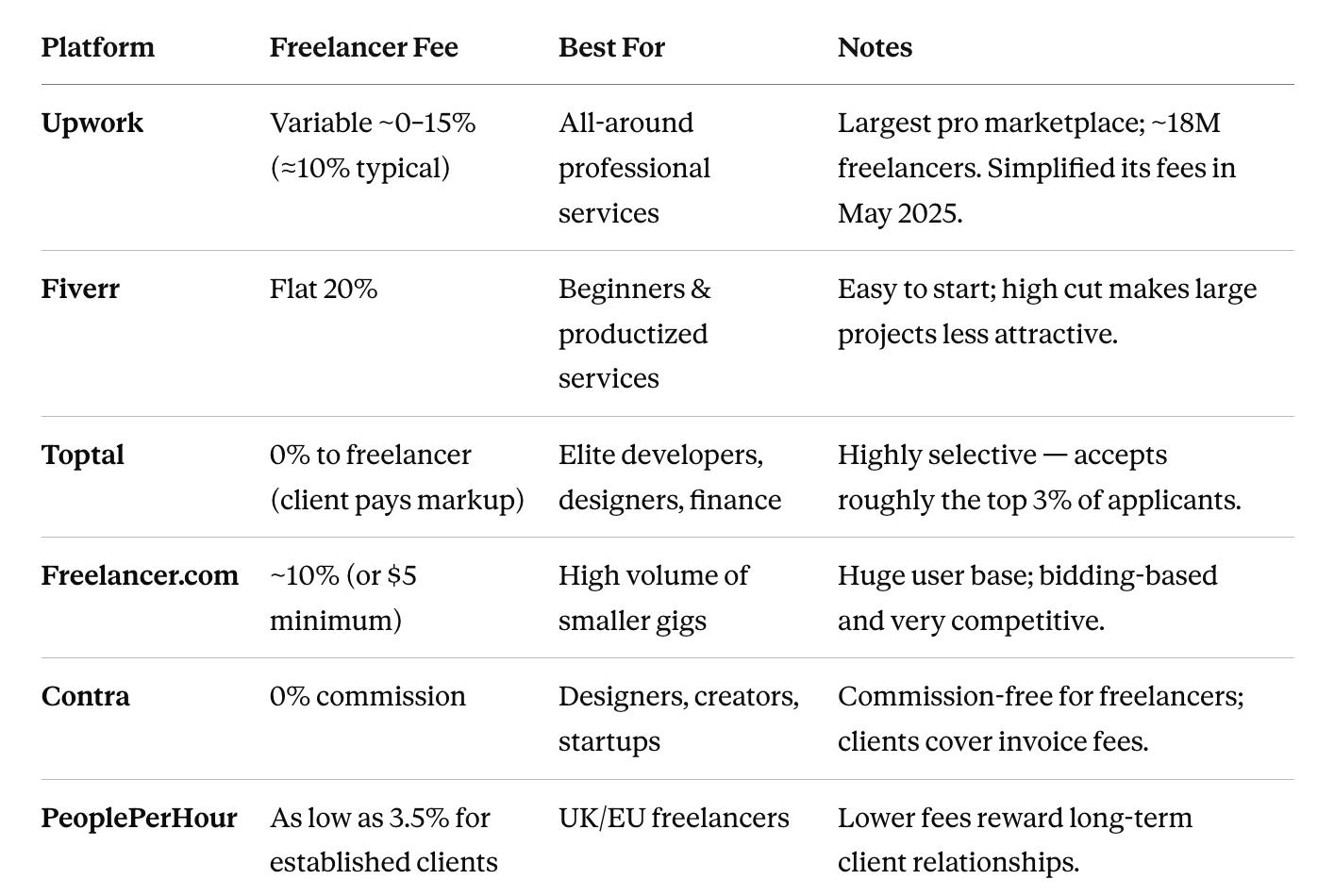
Fees change without notice — always confirm current rates on each platform's official site before committing.
A common path that works well: build your reputation and first reviews on a marketplace, then move repeat clients to direct invoicing to keep more of what you earn.
Pricing and Money Tips
How you handle money makes or breaks a freelance career.
The U.S. median freelance rate sits around $28/hour, but skilled specialists — developers, AI experts — command $100–$200/hour. Your rate is yours to set.
Don't sell yourself short
The most common beginner mistake is charging too little. A low starting rate is hard to escape, because even big percentage raises only go so far when you start at the bottom.
A useful habit: quote slightly more than feels comfortable. The worst case is a polite "no" and a negotiation. The best case is a yes — which happens more often than you'd think.
Think in projects, not just hours
An employee's $30/hour includes benefits, software, office space, and taxes paid by the employer. As a freelancer, you cover all of that, so your rate must be higher to match the same take-home pay.
Better yet, charge flat project rates when you can. That way you're paid for results, not for being slow — and getting faster at your craft doesn't cost you money.
Raise your rates regularly
Nobody hands a freelancer an annual raise. If you don't increase your rates, you'll be charging 2020 prices in 2026. Set a yearly date to update rates, and always give existing clients advance notice.
Keep your finances clean from day one
Open a separate bank account for your freelance income.
Track every payment and expense.
Set aside a portion of every invoice for taxes — treat it as money that was never yours.
Build a savings buffer to ride out the slow months.
Advanced Freelancing Tips for Growth
Once you've got a few clients, these strategies separate hobby freelancers from sustainable businesses.
Communication is your real product
Clients rarely remember the perfect deliverable — they remember how easy you were to work with. Reply promptly, set clear expectations, give honest timelines, and flag problems early.
A reliable communicator gets rehired and referred. A brilliant ghost does not.
Set firm boundaries
Just because you can work at 2 a.m. doesn't mean you should. Define your working hours, your turnaround times, and how many revision rounds a project includes — ideally in a written contract.
Boundaries don't scare good clients away; they signal that you're a professional running a business.
Always use a contract
A simple contract protects you from scope creep and unpaid invoices. It should cover deliverables, deadlines, payment terms, and revisions. Free templates exist online — adapt one and never start serious work without it.
Diversify your income
Relying on a single client is risky; if they leave, your income vanishes overnight. Aim for a few steady clients, and once you're stable, build assets that earn while you sleep — digital products, templates, or online courses.
Find your people
Freelancing can be lonely. A community of fellow freelancers offers advice, accountability, referrals, and reassurance that the ups and downs are normal. Local meetups, coworking spaces, and online groups all work.
Common Freelancing Mistakes to Avoid
Underpricing your work and getting stuck at a low rate for years.
Skipping contracts, then chasing unpaid invoices.
Saying yes to everything, including work you hate and clients who disrespect you.
Treating it like a vacation — flexibility still requires discipline and a routine.
Ignoring taxes until they become a painful surprise.
Never raising rates as your skills grow.
Avoid these six and you'll already be ahead of most beginners.
Frequently Asked Questions
What is freelancing in simple terms?
Freelancing is working for yourself by offering your skills to multiple clients on a project basis, rather than being a full-time employee of one company. You control your schedule, rates, and the work you take on.
How do I start freelancing with no experience?
Pick a skill you can demonstrate, create 2–3 sample projects to act as a portfolio, define a clear one-sentence offer, and start reaching out to your network and entry-friendly platforms like Fiverr or Upwork. Clients value proof of ability over a formal job history.
Is freelancing a stable career?
It can be. Income is irregular at first, but many freelancers build stability through repeat clients, multiple income streams, and savings buffers. Notably, about 60% of people who switched from full-time jobs report earning more as freelancers.
What are the best paying freelance skills?
Software development, AI and machine learning, data analysis, UX/UI design, and specialized marketing tend to pay the most. AI and ML specialists often charge $100–$200 per hour, well above the overall median of around $28/hour.
Which freelancing platform is best for beginners?
Fiverr, Upwork and Contra are the most beginner-friendly because they bring clients to you and protect your payments. Fiverr is great for packaged services; Upwork suits ongoing professional work. As you gain reviews, you can move clients to direct billing to reduce fees.
How much should I charge as a freelancer?
Calculate the annual income you want, add your business costs and taxes, then divide by your realistic billable hours. Compare that to market rates for your skill — and never anchor your price to an employee's hourly wage, since you cover far more expenses.
Final Thoughts
Freelancing rewards the people who start before they feel ready. You won't have the whole path mapped out, and that's fine — clarity comes from doing the work, landing that first client, and learning from each project.
Focus on the fundamentals: a skill people pay for, a clear offer, fair pricing, solid communication, and clean finances. Layer in boundaries and rate increases as you grow, and protect yourself with contracts and savings.
Do that consistently, and freelancing stops being a gamble and becomes what it is for millions of people today: a real, flexible, and genuinely rewarding career.